
Pompeii: What to See and How to Get There from Rome
Pompeii: What to See and How to Get There from Rome
Contenidos de esta página sobre Roma
- Day trip to Pompeii from Rome
- A brief history
- The great eruption of Vesuvius
- Day trip to Pompeii from Rome
- What to see in Pompeii
- Temple of Apollo
- Forum of Pompeii
- Temple of Vespasian
- Amphitheater of Pompeii
- Forum Baths
- Map of the Pompeii archaeological site
- Visiting the ruins of Pompeii
- Visiting Pompeii on a guided tour
- Day trip to Pompeii from Rome
- How to visit Pompeii on your own
- Tickets for the Pompeii site
- Day trip to Pompeii from Rome
- Fun facts about Pompeii
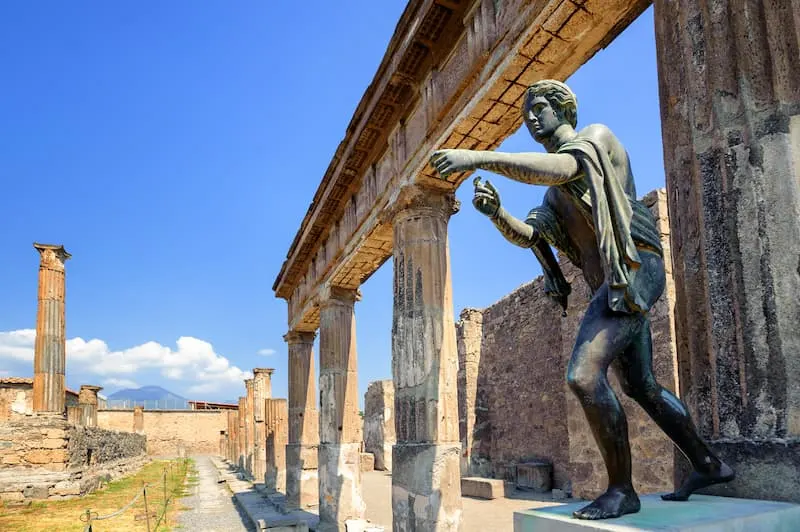
Pompeii is one of the most interesting day trips from Rome you can take. If you want to visit the ancient city at the foot of Mount Vesuvius and you're still not entirely convinced, you've come to the right place to clear things up.
We'll tell you about the origins of this remarkable archaeological site and what you'll find on your visit, plus the easiest way to take a day trip to Pompeii from Rome.
A brief history
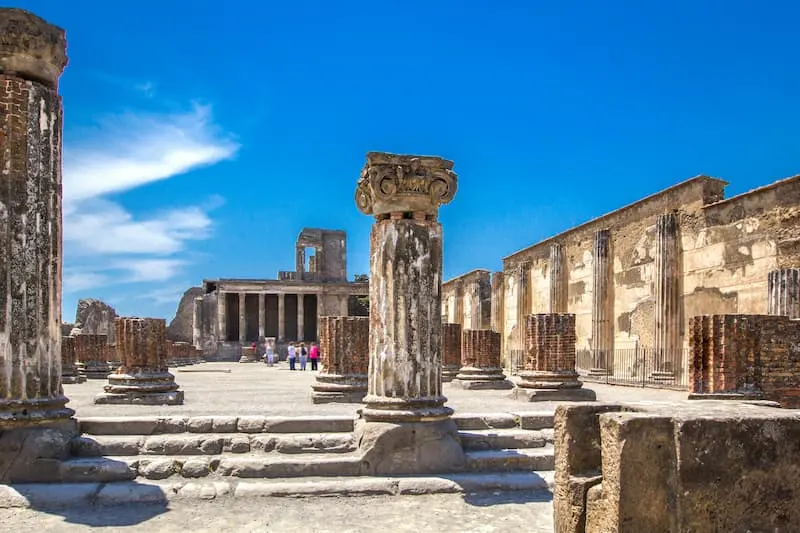
Before the eruption of Mount Vesuvius in 79 AD, Pompeii was a prosperous city with a population of between 15,000 and 20,000. Hard as it is to believe, the city's economy revolved around a port that today sits several kilometers from the sea.
The city, on the shores of the Bay of Naples, is thought to have been founded before the Greek invasion of the 8th and 7th centuries BC. Later, in the 6th century, the Etruscans walled the city. Finally, in the 3rd century BC, Pompeii became part of the ancient Roman empire.
Pompeii suffered several disasters before the great eruption of Vesuvius that would bury it for centuries. In 62 AD a major earthquake destroyed the aqueduct system, wrecked several public buildings and badly damaged parts of the forum, which still hadn't been fully rebuilt on the night Mount Vesuvius woke up.
The great eruption of Vesuvius
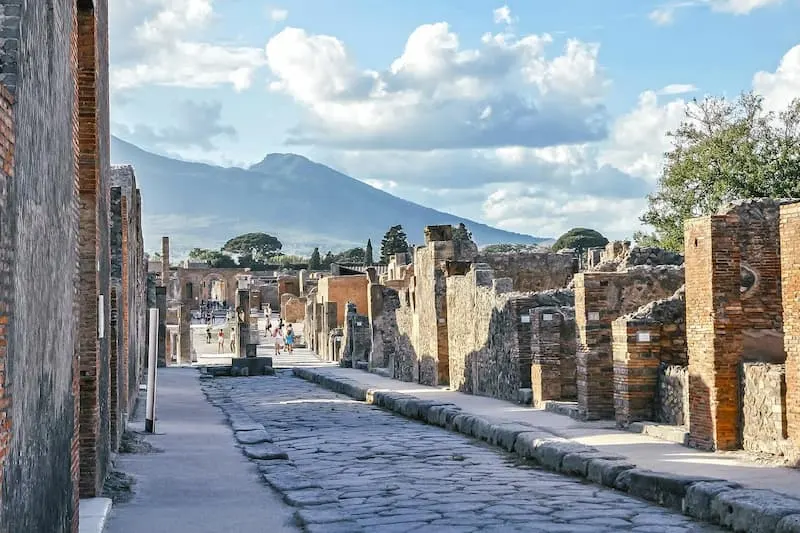
What happened in Pompeii? On the night of October 17 in the year 79 (until recently the disaster was thought to have taken place on August 24), Mount Vesuvius unleashed its fury with such force that many of the inhabitants of Pompeii, Herculaneum and Stabiae never made it out.
According to the writings of Pliny the Younger (the only surviving account from a witness to the events), that day began like any other until suddenly, around midday, the volcano erupted. A huge explosion threw out tons of ash and pumice that quickly blotted out the sky.
The account tells us that many people began leaving right away, but surely nobody imagined the scale of what would happen hours later.
At some point during the night, or in the early hours, all hell broke loose. Pyroclastic flows raced down the slopes of Mount Vesuvius toward the sea. And in their path, of course, stood the city of Pompeii.
Everyone caught by the pyroclastic flow died so quickly that they left behind a sea of mummified bodies in Pompeii that, almost two thousand years later, still seem to hold the illusion of life.
What to see in Pompeii
Visiting Pompeii from Rome is easy, but you should know that the archaeological site is enormous, so it's better to focus on the most significant areas, especially if you're only going for a day and your plans include seeing the charming city of Naples.
Here's our list of suggestions for what to see in Pompeii so you don't miss a thing.
Temple of Apollo
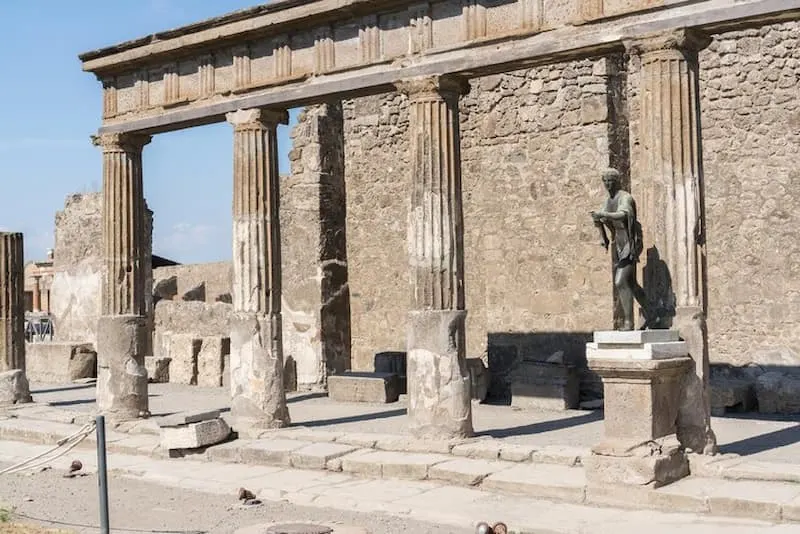
A temple dedicated to the sun god, and one of the oldest and most fascinating in the city. The access steps and some Doric and Ionic columns survive today. Several statues found during the excavations can be seen at the archaeological museum in Naples.
Forum of Pompeii
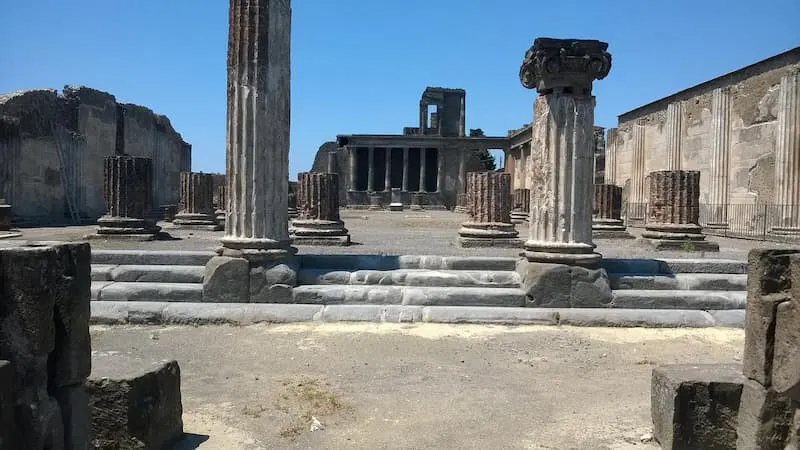
This was the economic, social, religious and cultural heart of the city. It was enlarged and embellished in the 2nd century BC. It was surrounded by public buildings and shops selling a wide variety of goods, while statues of gods and influential figures decorated the perimeter.
Temple of Vespasian
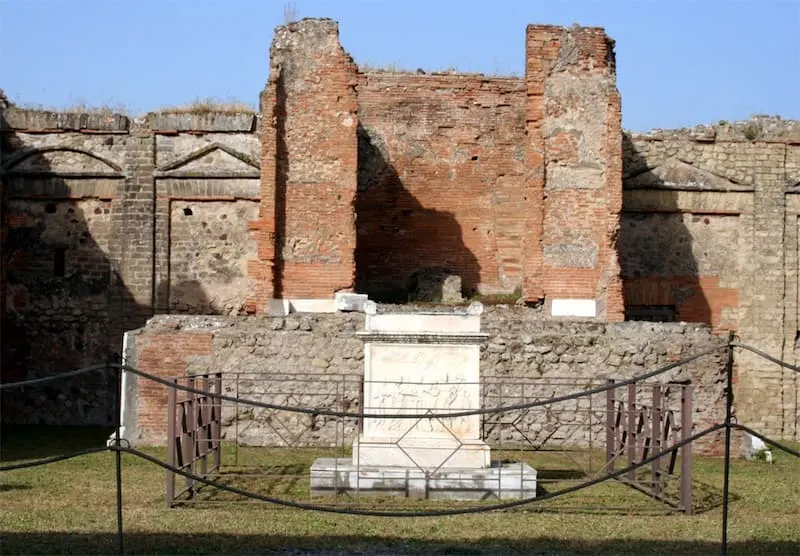
A temple dedicated to Emperor Titus Flavius Vespasian, who died months before the great eruption of Vesuvius. It was built with the finest materials and lavishly decorated. It was undergoing reconstruction after the major earthquake years earlier.
Amphitheater of Pompeii
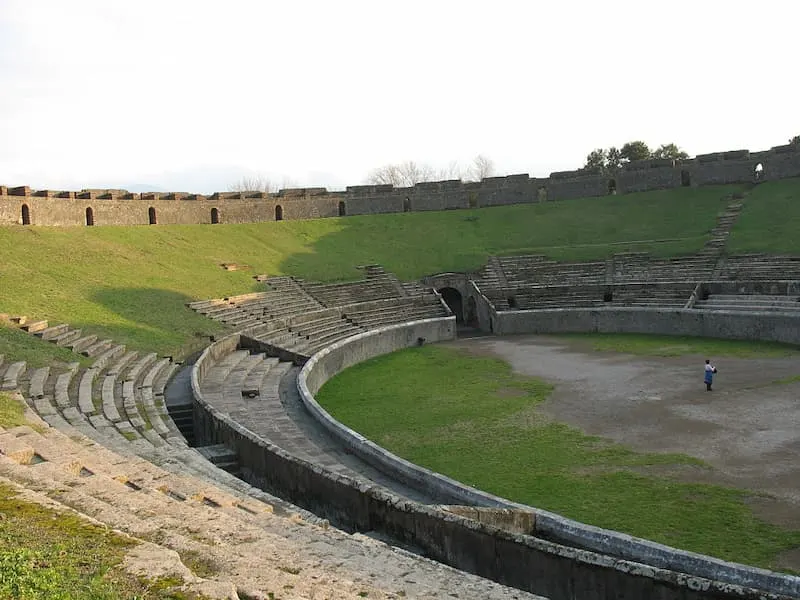
Pompeii's amphitheater doesn't compare in size to the Colosseum in Rome, but it was still a colossal building with room for around 12,000 spectators. It was built in 80 BC.
Forum Baths
This is one of the buildings that best withstood the eruption, and the passage of time too. Built in the 1st century BC, they still reflect the history of Pompeii.
The baths were a place for leisure and socializing, as well as playing an important role in the hygiene of Pompeians. Besides the frigidarium, tepidarium and caldarium, the baths also had pools, washrooms and space for massages.
Map of the Pompeii archaeological site
Below you can see the official map of the archaeological site. Click the image to view it in detail.

Visiting the ruins of Pompeii
To visit the ruins of Pompeii, the first thing to decide is whether you'll go on your own or prefer to book a tour of Pompeii to avoid wasting time unnecessarily. Whatever you decide, here's all the information you need.
Visiting Pompeii on a guided tour
Considering all the hassle you'll avoid, we're sure a guided tour of Pompeii is the most convenient option. The tour we offer costs just €77 and includes round-trip coach transport and priority entry to the archaeological site (to explore on your own). It also includes a panoramic drive through Naples.
This tour also comes in a version with a two-hour guided visit and lunch included. Check the details using the button below and choose the option that suits you best.
How to visit Pompeii on your own
Below we explain the ways to get to Pompeii using Rome's public transport.
Pompeii from Rome by train
The fastest way to get from Rome to Pompeii is by high-speed train. These trains leave from Roma Termini station and run to Naples central station. The journey takes a little over an hour, but keep in mind that the fare varies depending on when you book. Tickets cost between €15 and €30.
- To reach Termini station, take metro lines A and B on the Rome metro, or check which bus line runs closest to your starting point.
- Once in Naples, at the same central station, you'll need to buy another ticket for the Circumvesuviana local train to the Pompei Scavi stop. That leg takes about 40 minutes and costs €3.
- When you get off at Pompei Scavi station, it's a short walk to Porta Marina, one of the main entrances to the Pompeii archaeological site.
Pompeii from Rome by bus
Taking the bus from Rome to Pompeii has its drawbacks. The first is that neither of the two bus terminals serving Pompeii is in central Rome. The terminals are Autostazione Tiburtina and Anagnina.
Keep in mind that the bus trip from Rome takes about 3 hours, so if you're planning a round trip in a single day, we really don't recommend this option. And in case you're still wondering: the bus ticket costs €9 and it drops you in Naples, so you'll have to take the local train anyway to reach the ruins of Pompeii.
Tickets for the Pompeii site
- Basic ticket: €21 (buy your basic ticket here)
Bear in mind that depending on when you visit, your best bet is to buy your skip-the-line ticket online in advance so you don't waste time queuing. That's if you go on your own, of course, because if you book our Pompeii tour you won't have to worry about a thing.
If you're visiting Pompeii, don't miss neighboring Herculaneum, a town also buried by Vesuvius. It's a little smaller but just as interesting and beautifully preserved.
Fun facts about Pompeii
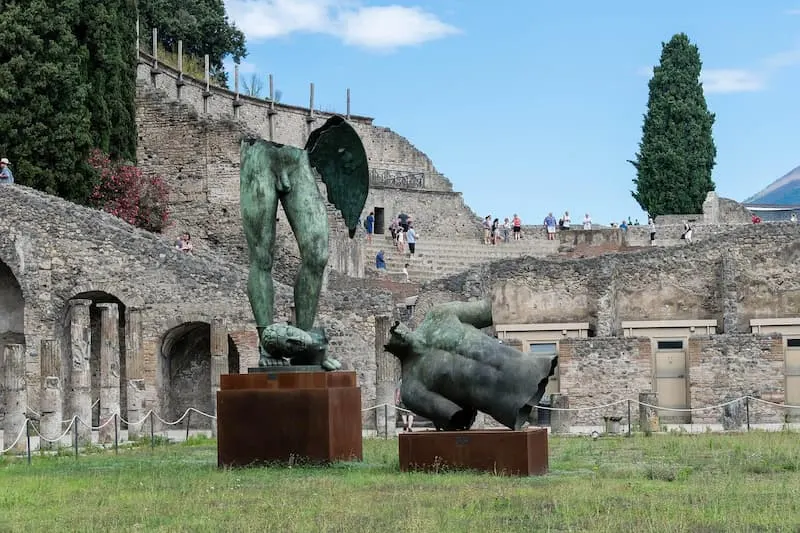
- The eruption of Mount Vesuvius buried Pompeii under a thick layer of volcanic material. Thanks to that, the city has survived just as it was, right down to our own day.
- Its ruins weren't discovered until 1748.
- The homes of wealthy families were single-story, while less well-off Pompeians lived in multi-level wooden houses.
- Pompeii's prostitutes dyed their hair red and wore knee-length tunics, which made them easy to recognize.
- The Lovers of Pompeii are two bodies caught in an embrace by death during the eruption. For a long time they were thought to be two women, but recent DNA studies showed they are in fact two men.
- The bodies of plants, animals and people you can see in Pompeii today are actually casts, made using a technique dreamed up by a 19th-century archaeologist.
- Most of those who died in the eruption were elderly people, young children, pregnant women and those with mobility problems.
- So far, 60% of the city of Pompeii has been excavated, but preserving that 60% is such an enormous job that the rest will very likely never be dug up.
- During World War II, an American military base was buried under a thick layer of ash following an eruption of Mount Vesuvius.
- Legendary rock band Pink Floyd recorded one of their most famous performances, Live at Pompeii, in the amphitheater of the city's ruins.