
Piazza del Popolo: Rome’s Grand Gateway to the City
Piazza del Popolo: Rome’s Grand Gateway to the City
Contenidos de esta página sobre Roma
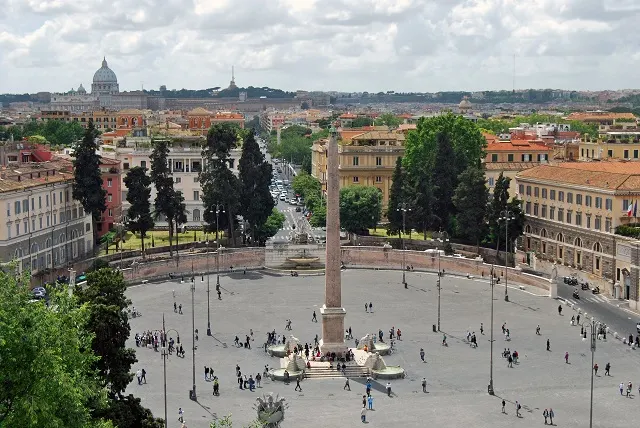
Piazza del Popolo has long been a hugely important meeting point for the people of Rome. All kinds of events were held here: games, fairs, folk performances, and sadly also countless executions.
Today it is one of Rome's liveliest squares and one of the essential things to see in Rome.
The origins of Piazza del Popolo
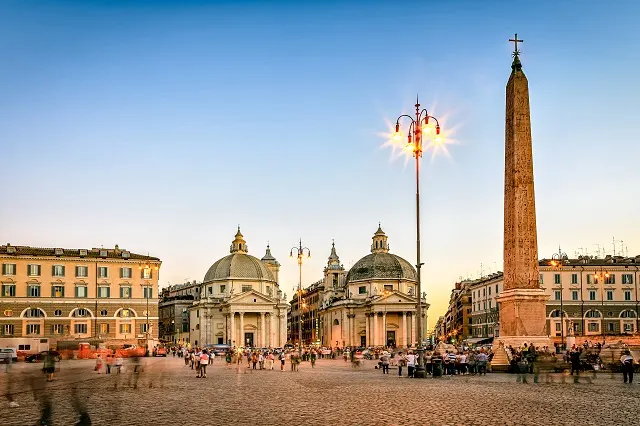
There are several theories about where the name «Piazza del Popolo» comes from. The most plausible is that it takes its name from the Basilica of Santa Maria del Popolo, which stands right next to the Porta del Popolo.
According to legend, it was built at the people's expense to bring peace to the restless ghost of Nero, said to be prowling around the area.
It is also said that the name may come from the many poplar trees that once grew here, «populus» in Latin.
In the 17th century the twin churches were designed. Despite the very different shapes of the two plots, the architect Rainaldi used an optical trick to make them look identical, and they became a key feature of the square.
The obelisk in Piazza del Popolo
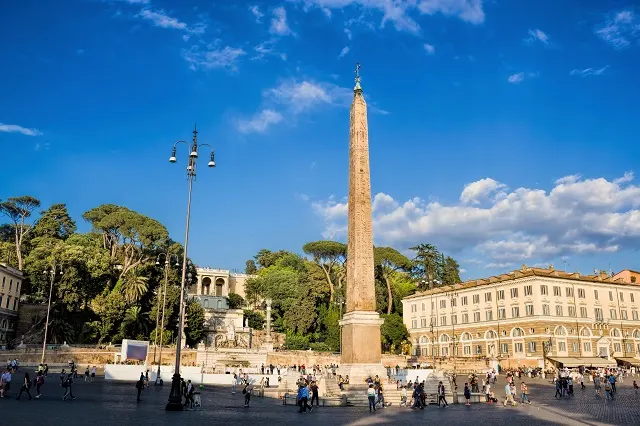
On March 25, 1589, the Flaminio Obelisk was moved to Piazza del Popolo. At 23.20 meters tall, it is the second oldest in Rome. It previously stood at the Circo Massimo and dates back to 10 BC.
This pagan obelisk, dedicated to the Sun god, now stands, ironically, among three churches dedicated to the Virgin Mary. The fountain and the lions were added much later, in 1823, by Valadier, under the papacy of Leo XIII.
Thanks to its wide pedestrian spaces, Piazza del Popolo hosts many public gatherings. Concerts, political rallies and protests take place here, as well as flash mobs, which can «pop up» in any public space in Rome to liven things up.
Three of Rome's main streets begin at this square, in the Campo Marzio district: Via del Corso, Via del Babuino and Via di Ripetta.
Right next to the square are the lovely gardens of Villa Borghese, the most beautiful and important park in Rome, along with the Galleria Borghese museum.
From here you can also walk to the nearby Spanish Steps (Piazza di Spagna).
How to get there
Address: Piazza del Popolo. Flaminio metro or train station